Surreal Women or "Yes gentlemen, SHE is more than just a muse!"


AND (click here) for a short interview with San Francisco State's very own Professor Emerita Dr. Whitney Chadwick who pioneered the study of WOMEN and SURREALISM!


Surrealism or "The Reality Above"

The False Mirror, René Magritte, oil on canvas, 1928

SAY THE WORD OUT LOUD 
THREE TIMES 
IN 
FRONT OF A MIRROR 
AT 
MIDNIGHT 
AND 
SEE WHAT HAPPENS!

(or just click the links if you don't like scaring yourself 
or 
if you believe something incredible could happen 
and 
the incredible is something that you are not accustomed to experiencing.)


POST SCRIPT: 
SEE WHAT COULD HAVE HAPPENED 
HAD YOU TRIED THE OLD 
MIRROR- AT-MIDNIGHT TRICK?


The surrealist group in Paris, circa 1930. From left to right: 
Tristan Tzara, Paul Éluard, Andre Breton, Hans Arp, Salvador Dali, Yves Tanguy, 
Max Ernst, Rene Crevel, Man Ray.


WHO WERE THE SURREALISTS OF PARIS 
(and other places too)?


"Surrealism" from the BBC TV series "The Shock of the New"


Paris Was A Woman (1996 documentary)

From Zeitgeist Video:
In the early decades of the 20th century, Paris was the undisputed artistic capital of the world. Cultural titans Gertrude Stein, Colette, Djuna Barnes, painter Marie Laurencin, publishers and booksellers Sylvia Beach and Adrienne Monnier, and New Yorker journalist Janet Flanner (not to mention Ernest Hemingway, Pablo Picasso and James Joyce) were all part of the between-the-wars Left Bank inner circle. Utilizing groundbreaking research, newly-discovered home movies and intimate storytelling that intertwines interview with anecdote, this award-winning documentary re-creates the mood and flavor of a unique female artistic community who flocked to the City of Lights during its most magical era. This Edition features rare home movies of Stein, Alice B. Toklas and Picasso.   


A Moveable Feast, The Restored Edition

In 2009, Scribner published a new, controversial, version of Ernest Hemingway's A Moveable Feast, edited by his grandson, Seán Hemingway. (The original version, which is the one we are reading in class, was published by his fourth wife after Hemingway's suicide in 1961.) Some of the controversy is over the portrayals of Hadley, his first wife, and Pauline, his second wife, who appears, unnamed, at the very end of the book. But the new edition is not necessarily more "definitive" than the old edition and many Hemingway scholars do not think it is more authentic, though it does include some new material.

Here is an article about the new edition and the controversy in The New York Times and another in The Globe and Mail.

Hemingway's friend and biographer, A.E. Hotchner, wrote this disapproving op-ed when the new edition came out. Scholars have expressed doubt with his version of events.

And finally, here's a response from Seán Hemingway on Book TV.


Paris avant-garde art: two upcoming exhibitions

This summer, San Francisco will host two important exhibitions of paintings that relate to the Parisian avant-garde.

The first will be at the SF Museum of Modern Art:
The Steins Collect Matisse, Picasso, and the Parisian Avant-Garde
May 21-September 6

The second will be at the DeYoung Museum:
Picasso: Masterpieces from the Musée National Picasso Paris
June 11-October 9

Continue your education!

Discussion questions for Hemingway, A Moveable Feast


On Thursday, we will be discussing Ernest Hemingway's memoir of his time in Paris in the 1920s, A Moveable Feast. Below are some questions to consider:

1) How does Hemingway survive in Paris?

2) In what ways is the city important to his writing?

3) What are his relationships with the other expatriate writers in Paris?

4) What impression of Paris does his memoir leave you with?

A Salon at 27 Rue de Fleurus

Photograph by Man Ray, 1923

The American experimental writer Gertrude Stein and her life-partner Alice B. Toklas, held court at their Paris apartment 27 Rue de Fleurus for 33 years. Great authors, artists and composers visited them on a daily basis and Gertrude was responsible for helping to launch many a career. To learn more about Stein, Toklas and their world at 27 Rue de Fleurus in Paris see the links below.

Jean Cocteau: The "Jacques"-of-All-Arts


Imagine being so talented that you could work in every medium of fine and performing arts and be hailed for what you created in each category. Jean Cocteau was just such a person. Painter, designer, playwright, novelist, poet, set and costume designer, illustrator, film-maker and librettist for operas and ballets, Cocteau was also a close friend of all the notable names of modern art and culture through the first half of the twentieth century. Learn more about his amazing output here.

 Four of Cocteau's films are considered classics and all are available in restored deluxe editions from Criterion Film Collection. Beauty and the Beast is a witty, re-imagining of Perrault's classic French fairy-tale. Three films made over the course of thirty years use the mythical Greek musician Orpheus as a way to understand human creativity and the universal journey from birth to death.


The Orphic Trilogy: The Blood of the Poet (1930), Orpheus (1949) and The Testament of Orpheus (1959)


Cocteau also wrote the text for several operas. Below are scenes from two of them Oedipus Rex with music by Igor Stravinsky (composer of Rite of Spring) and The Human Voice by Francis Poulenc (composer of Dialogues of the Carmelites which we saw during the lecture on the guillotine in class).


Pablo Picasso and Henri Matisse

 Two of the most well-known artists of the twentieth century are Pablo Picasso and Henri Matisse. Both men spent significant parts of their lives making art in Paris. The BBC has made excellent TV documentaries on both of them. Below are the first parts of the two episodes. To see the full episodes visit Youtube.


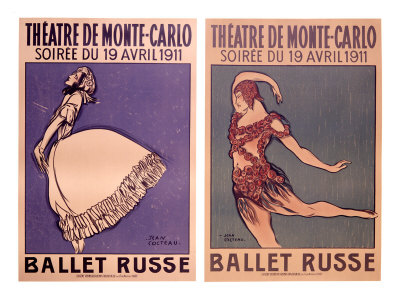
The Innovations and Controversies of the Ballet Russe


The Ballet Russe took Paris by storm in the second decade of the twentieth century. The innovative uses of choreography, music, set design and costumes had an enormous effect on modern culture. The founder Sergei Diaghilev had a talent for mixing styles and for bringing the avant garde geniuses of many countries together to collaborate on his ballets.

 Diaghilev, by Leon Bakst

Two of the most controversial works that his company performed were The Rite of Spring (1913) and The Afternoon of Faun (1912). Both scandalized much of the audience for their violence and frank depictions of sexuality. But beyond the subject matter (both drew on ancient myths and legends) it was the new choreography of Vaslav Nijinsky and the bizarre rhythms of Stravinsky (Rite of Spring) that caused the greatest consternation. Diagilev and the Ballet Russe did much to solidify the reputation of Paris as a center of artistic innovation and creative experiment in the years leading up to the first World War. Below are professional recreations of these two important modern ballets.


The Victoria and Albert Museum is the largest owner of costumes from the Ballet Russe.Here is an interesting talk by one of their curators on the beautiful but nearly unwearable costumes designed by Nicholas Roerich for The Rite of Spring. Click HERE to hear the 18 minute talk!